
Most people only think about their water heater on the day the hot water runs out, and that's normal. Nobody spends their free time wondering about it. We often hear a customer say the heater went in a couple of years back, and then the label shows it was made nine years ago.
If you aren't sure how old your heater is, you probably don't know who put it in or how carefully. On every call, a few details tell us whether the heater was installed by someone who knew the work, by a beginner, or by the homeowner. These are the four we check first.
1. Is the venting right?
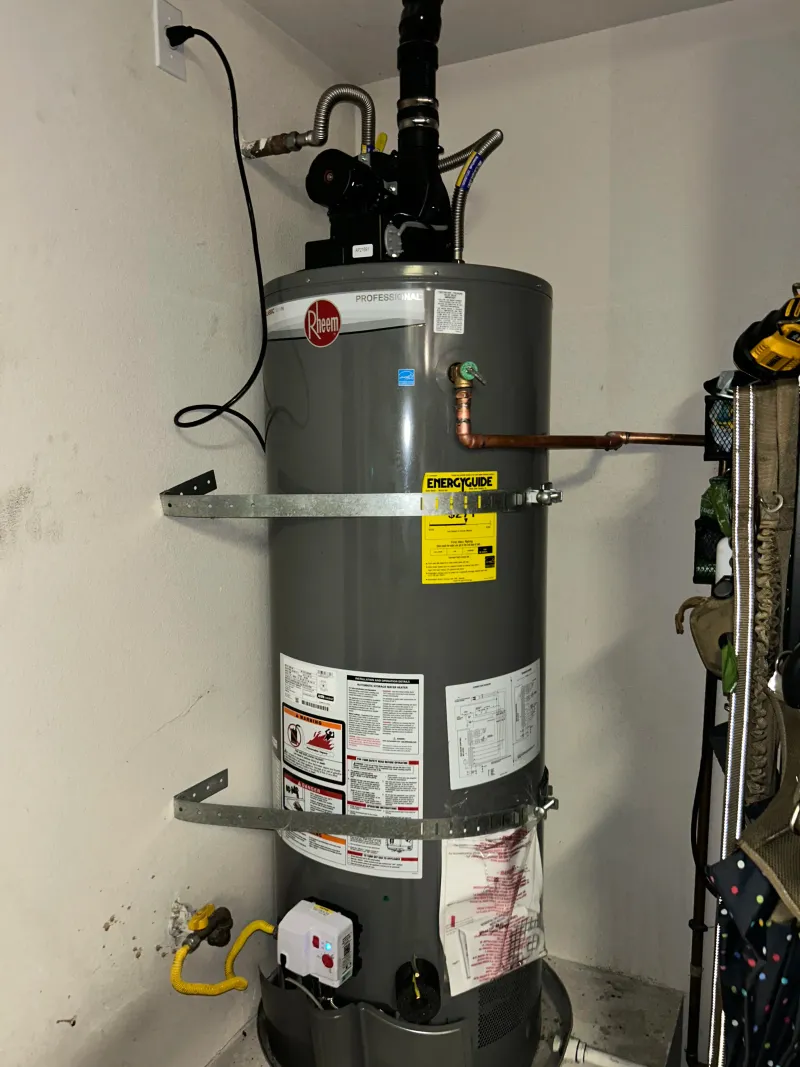
Venting is the first thing we look at. We have lost count of the tank water heaters we've found vented with dryer duct.
Tankless heaters need correct venting even more. A tankless unit is forced air, not atmospheric. With the wrong vent, or a vent that isn't airtight, it can push carbon monoxide into the rooms you live in, and that can be fatal. If you're weighing the two types, we compare them on our tankless water heater page.
What to look at: a vent that looks like dryer duct is a problem. If you suspect the venting is wrong, stop using the heater and call a licensed plumber. This is not a DIY repair.
2. Are the seismic straps anchored properly?
Even on installs that look clean, we have found the straps done wrong. Sometimes the two ends aren't joined correctly in the middle, and sometimes they're fastened in the wrong spots. We have seen straps anchored straight into drywall with no stud behind them, and some held up with drywall anchors.
A water heater can weigh 400 pounds. In an earthquake, a screw in drywall won't hold that kind of weight.
What to look at: follow each strap to the wall. If it's fastened into bare drywall or a drywall anchor instead of a stud, or the ends aren't joined properly in the middle, have a plumber take a look.
3. Is the thermal expansion tank on the cold side?
It belongs on the cold side, never the hot side. We find expansion tanks on the hot side more often than you'd expect.
Some people leave the expansion tank out because skipping it saves money today. It costs more down the road. We once installed a Moen leak detection device for a customer, which tracks water pressure and usage and catches leaks. He called us the next day because it showed 170 PSI, which is extremely high. When we went back to find the cause, his water heater had no thermal expansion tank at all.
A missing or misplaced expansion tank stresses more than the tank itself. It strains every part of the plumbing in the house. We cover what high pressure does over time on our water pressure regulator page.
What to look at: if your heater has an expansion tank, it should be on the cold water line. If it's on the hot side, or there's no tank at all, have a plumber check it.
4. Is the sediment trap installed backwards?
Sediment traps are another part we often find installed wrong. The trap catches sediment before it can reach the gas control valve. Many installers leave it out completely, and that is a big reason gas control valves fail.
Even when a trap is there, the tee is sometimes set with the reservoir pointing down while the gas runs straight across. The gas never drops into the chamber first. It should flow down into the chamber, where the sediment gets caught, and only then continue to the gas control valve. Set up backwards, the trap mostly defeats its own purpose.
What to look at: this one is hard for a homeowner to judge, and it's a gas line, so look but don't touch. If you can't find a sediment trap, or you aren't sure it's set up right, ask a plumber to check it on the next visit.
What should you do if you spot one of these?
Leave the fix to a professional. Venting, gas lines and straps all have to be done right, and bad venting can hurt someone. If you suspect a venting problem, stop using the water heater and call a licensed plumber.
The other three are still worth having checked. Too many installers set the heater, collect payment and move on. A proper water heater installation gets the venting, straps, expansion tank and sediment trap right the first time. Cutting the sediment trap or the expansion tank to save money now takes years off the heater's life.
Frequently Asked Questions
Need Help With Your Plumbing?
Regal Plumbing & Rooter serves Ontario, Rancho Cucamonga, Fontana, Pomona, Corona, Upland, West Covina, Chino and surrounding communities. Call us 24/7.
Call Now: (909) 600-4561