
Most of the sewer and drain trouble we see in Rancho Cucamonga comes down to two things: tree roots and old pipe that has rotted from the inside. Two jobs in the city show both problems, and what it took to fix them.
Why do so many Rancho Cucamonga sewer lines back up?
Roots are the most common reason a main line clogs here. Any yard with a tree is at risk, and once roots find a way into a sewer, the sewage feeds them, so they keep getting bigger and stronger.
In clay sewer pipe, roots get in at the hub connections where the sections join. As they grow, they can push the pipe apart and even break it. ABS pipe with glued joints usually keeps roots out.
Age is the other half of it. In the older parts of the city, homes from the '50s and '60s often have cast iron inside the house, and by now a lot of it is rotted and heavily scaled. That buildup is what causes repeat backups.
Can a tree root crush a sewer line without getting inside?
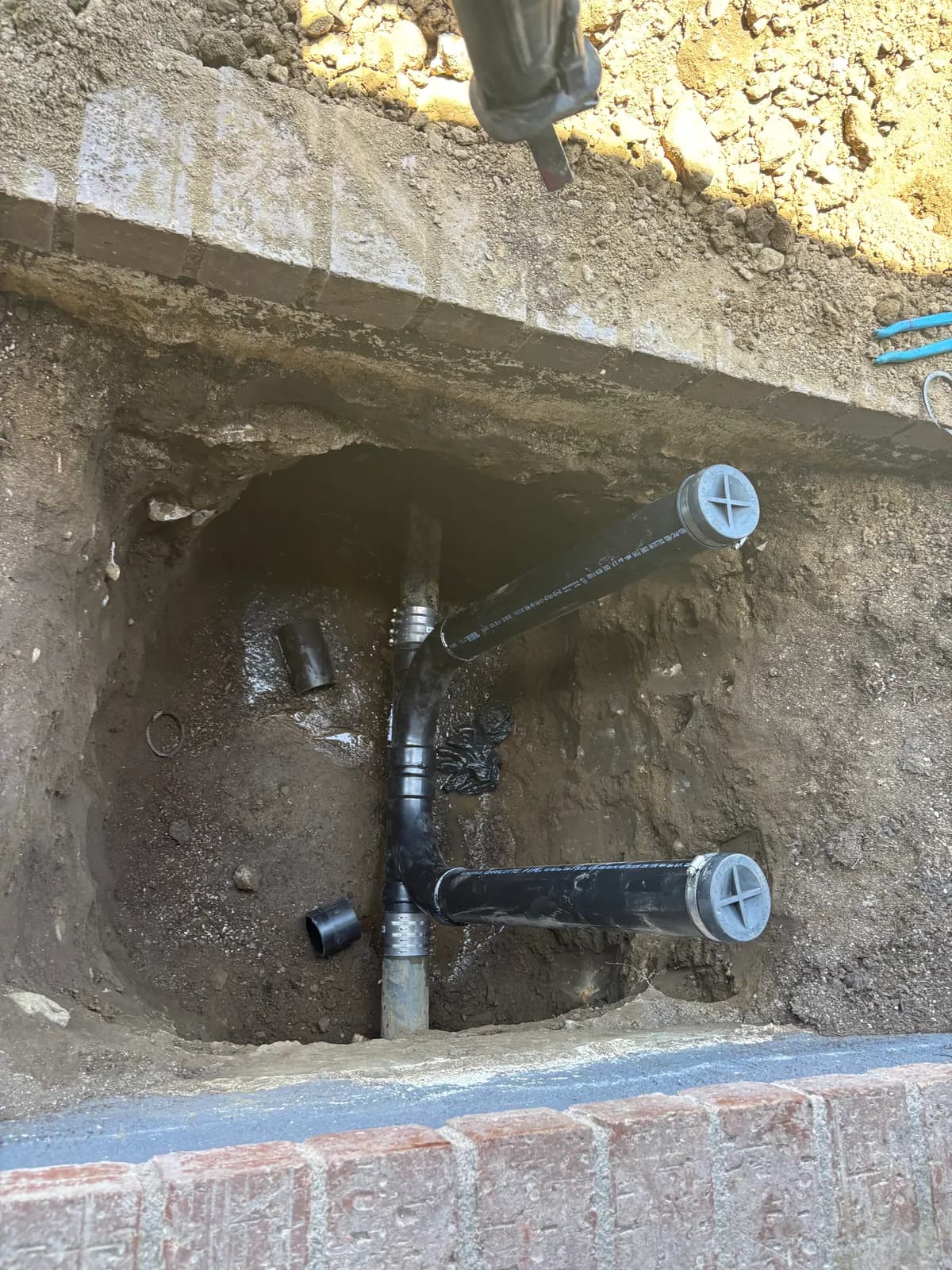
Yes. On a job in Alta Loma, up in northern Rancho Cucamonga, a eucalyptus root had grown along the outside of an ABS sewer line for about 60 feet. It never broke into the pipe. It simply squeezed it from the outside until the line was folded in half and flattened like a pancake.
That job stays with us because of the depth. The sewer started about 3 feet down and dropped to about 9 feet. To reach it, we trenched across the entire yard with a 4-ton excavator.
Depth is one of the biggest things that drives the size of a sewer job, along with where the line runs and what kind of soil we are digging through. Our sewer line repair page explains how we decide between a spot repair, a liner and a full replacement.
What happens when an older house has no cleanout?
Without a cleanout, there is no access point into the sewer for a snake or a hydrojetter. That leaves two poor choices: pull a toilet or try to get in through the roof vent.
Pulling a toilet on a backed-up house lets all that sewage rush out at the toilet flange, the lowest point. Going through the roof often fails too, because many vents have hard 90s that a cable can barely get around, if at all.
Homes from the '50s and '60s commonly have no cleanouts, and we see plenty of them in the older parts of Rancho Cucamonga. Adding one typically runs anywhere from $850 to more than $4,000. Where it goes and how big the pipe is set the price.
What did we find under a kitchen in Etiwanda?
A kitchen clog is almost always grease, and jetting usually cuts it loose. Our drain cleaning page covers how we handle those. This one was different. The house was an older home in Etiwanda, right next to Etiwanda High School, and it had no cleanouts, so we went up on the roof to hydrojet the kitchen line.
Dirt came up into the kitchen sink. That told us the pipe had rotted out completely. We replaced the kitchen line, which meant jackhammering a trench of about 30 feet across the kitchen floor to the closest bathroom, then tying in to the existing branch line.
The branch line was packed with dirt as well. When we jetted it, pieces of pipe started breaking away, so that line had rotted too.
Then came the septic tank. The home was on septic, and the owner did not know it had gone 30 years without being pumped. It was full to the brim, with 30 years of crust and buildup we had to break up to get it out. One clogged kitchen sink had turned into three separate problems.
Will hydrojetting get rid of roots for good?
No. Hydrojetting cuts roots up and flushes them out to the main, but it works more like a band-aid. Once roots are cleared, expect them back in about 6 months.
Roots that have found a way in stay until the opening is closed off. That means lining the pipe or cutting out the damaged section and replacing it.
A liner is only an option when the pipe is lineable, with no bellies and no big offsets. When a line can be dug up and replaced, that is always our top choice, because every hub on new ABS is glued and the glue forms a chemical bond.
How often should you have your sewer checked?
Once a year. We recommend an annual camera inspection to catch roots, buildup, offsets and breaks before they back the house up. For an older home with cast iron, we suggest hydrojetting the lines every 1 to 3 years, or at minimum a camera inspection on that schedule.
We like to have you watching the screen with us so you see exactly what we see. If you can't be there, we record the inspection and email or text you the video. Our guide to yearly sewer camera inspections covers what the camera looks for.
If your drains are slow, gurgling or backing up, call (909) 600-4561 and we will find out what is going on in the line.
Frequently Asked Questions
Need Help With Your Plumbing?
Regal Plumbing & Rooter serves Ontario, Rancho Cucamonga, Fontana, Pomona, Corona, Upland, West Covina, Chino and surrounding communities. Call us 24/7.
Call Now: (909) 600-4561