
Most plumbing problems give you a warning before they become emergencies. Sewer lines are the same way. A yearly camera inspection is the simplest, cheapest thing you can do to catch a problem when it's still a problem and not a Saturday-night flood.
Why "annual"
Here's the truth about main line backups: they don't happen on a quiet Tuesday morning. They happen Friday after 5, on the weekend, on Thanksgiving with a houseful of family, on Sunday during the big game. They happen at the worst possible moment, because that's when your line is under the most use. A line that's been struggling silently can usually handle a normal weekday. Add a houseful of people using bathrooms and kitchens at the same time, and the line that's been giving you warning signs for a year finally gives up.
When the sewer's out, nothing in the house works. No toilets. No showers. No laundry. No dishes. For a family of four, that goes from inconvenient to a real problem inside of one day. The cost of cleaning up after a backup, plus the emergency call to clear the line, plus the actual repair if there's a root or a break, adds up to a number you don't want to add up.
A yearly camera inspection costs almost nothing compared to that, and most of the time it catches the problem early enough that the fix is cheap or even no fix at all.
What we're looking for
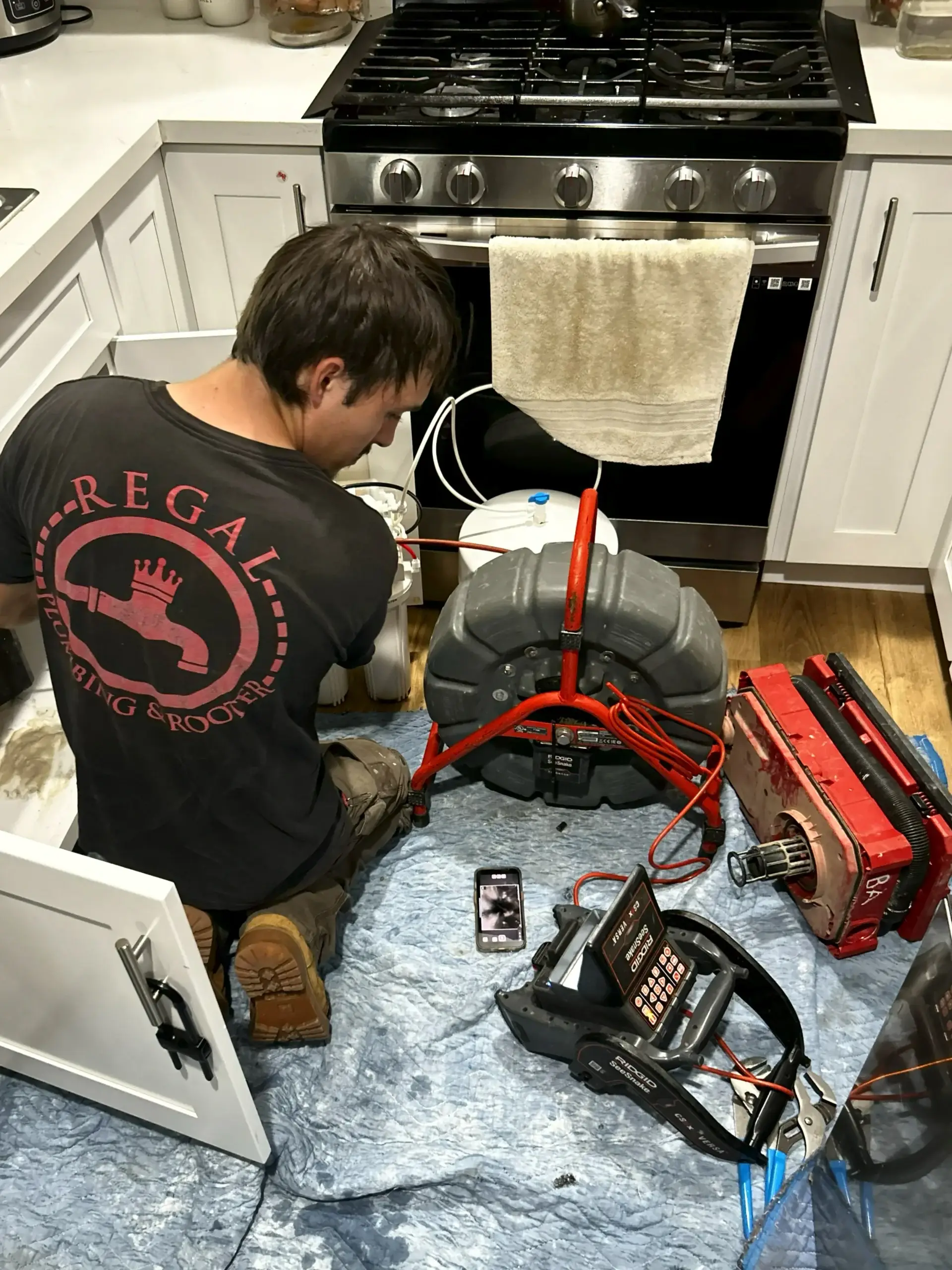
A camera inspection takes about an hour. We put the camera down the line at your cleanout and walk it all the way to the city main. As we go, we're watching for a few specific things.
Roots are the big one. Around here, especially in older parts of Upland, Fontana, Rancho Cucamonga, and Pomona, roots find their way into clay pipe joints and start growing inside. You can see them clearly on the camera. Small roots we can clear and you can buy yourself another year or two. Big root masses tell us the joint is separating and the line needs a real repair, not just another clearing.
Buildup is the next thing. Grease from kitchen drains, soap scum from bathroom lines, and mineral scale from the hard water around here all collect on the inside of the pipe and narrow the flow. You can see it on the camera as a coating on the pipe walls. If it's thick enough that water is starting to back up behind it, hydro jetting clears it and resets the clock.
Then offsets, bellies, and breaks. An offset is where two sections of pipe have shifted out of alignment. A belly is a low spot where water pools and solids settle out. A break is exactly what it sounds like. The camera shows us all three, and once we see one, we know what kind of repair you're looking at and we can give you the honest read on whether you need it now or whether you can wait.
You watch with us
When we run the camera, we want you standing right there at the screen. You see what we see. We tell you what you're looking at as the camera moves. If something is wrong, we'll point it out and explain how it most likely happened. If everything looks clean, you've got a baseline you can compare against next year. If you can't be home for the inspection, we record the whole thing and send you the video.
There's no upsell on a clean line. When the camera shows your sewer is fine, that's the answer and we tell you. We'd rather see you back next year than try to make a job out of a line that doesn't need one.
Who should be on a yearly schedule
Some homes can stretch the inspection to every couple of years. Some really should be on a yearly schedule.
Yearly is smart if you have mature trees within 20 feet of your sewer line, especially eucalyptus, ficus, or sycamore. It's smart if your home was built before 1970 and you still have the original clay or cast iron drains. It's smart if you've ever had a previous backup. And it's smart if you have a houseful of people, because more use means more wear on every fixture and line.
Newer homes with PVC laterals in newer neighborhoods can often stretch to every two or three years. We'll tell you which one you are after the first inspection.
Schedule it before the rainy season
The best time to schedule is in the early fall, before the holidays and before the rainy season starts. Wet ground softens soil around clay pipe joints and lets roots push in faster, and the holidays put the most use on your line all year. Catching anything before October buys you time to make a repair in normal hours instead of holiday emergency mode.
Call us at the office and we'll get you on the schedule. The inspection itself is cheap insurance against the kind of weekend you don't want.
FAQ
How long does a sewer camera inspection take?
About an hour in most cases. The camera goes down at the cleanout and we walk the whole line to the city main, so the time depends on the length of your lateral.
Do I need to be home for it?
We prefer it because there's real value in watching the screen with us and seeing what we see. If you can't, we record the inspection and text or email you the video.
What if you find something wrong?
We tell you what it is on camera, explain what most likely caused it, and lay out your options. Sometimes the fix is hydro jetting, sometimes it's a spot repair, sometimes it's a liner or a full replacement. We don't push you toward a bigger repair than the line actually needs.
Will the camera inspection clog or damage my line?
No. The camera is a flexible cable with a small camera head on the end. It moves through the line without doing any damage. If we run into roots or a blockage, we stop and tell you what's there.
How often should I do this?
Most homes do well on a yearly schedule. Newer homes with PVC laterals can sometimes stretch to every two or three years. We'll give you a real answer after the first inspection based on what your line actually looks like.
Can a yearly inspection prevent a backup?
Most of the time, yes. Backups don't usually happen out of nowhere. They build up over months as roots grow or buildup thickens, and the camera catches them long before they're bad enough to back up. Catching it early means you fix it on your schedule instead of on a Friday night.
What if I already had a backup recently?
Have us run the camera as soon as the line is clear. A backup that just happened tells you the line had something in it, but the camera tells you why, and that's what determines whether it'll happen again next month or whether the clearing actually fixed it.
Need Help With Your Plumbing?
Regal Plumbing & Rooter serves 32+ cities across the Inland Empire. Call us 24/7.
Call Now — (909) 600-4561